Borrowing Parameters
Each asset in a lending market defines two key parameters that determine how much can be borrowed and when a position becomes unsafe:
- Maximum Loan-to-Value (mLTV) — borrowing limit
- Liquidation Threshold (LT) — solvency limit
These parameters control both borrowing power and Health Factor within the market.
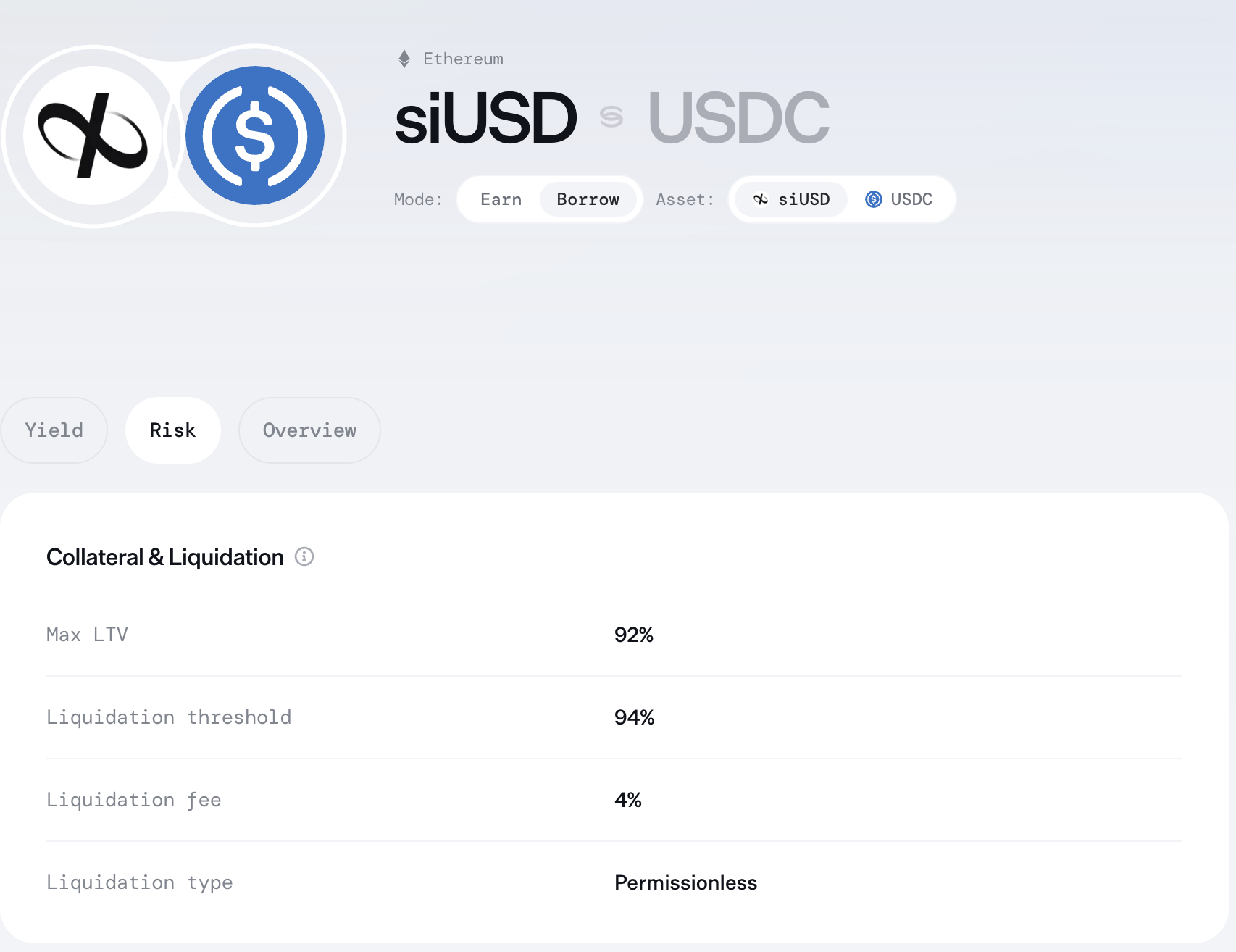
In this example, the collateral asset siUSD has a Max LTV of 92% and an LT of 94%. This means a user can borrow 92% of their siUSD deposit, and they might experience partial liquidation if the loan value exceeds 94% of their collateral value.
Maximum Loan-to-Value (mLTV)
The Max LTV defines the maximum amount a user can borrow against their collateral and is calculated as follows:
For example:
An mLTV of 92% means you can borrow up to 1.00 of collateral
If your position reaches this limit:
- You cannot borrow more
- You must add collateral or repay debt to increase borrowing capacity
Max LTV is a hard cap on leverage.
Liquidation Threshold (LT)
The Liquidation Threshold (LT) defines when a position becomes eligible for liquidation.
For example:
An LT of 94% means your position may be liquidated if your LTV exceeds 94%
Between mLTV and LT:
- You are allowed to borrow
- But your position is increasingly at risk
Once LT is exceeded:
Liquidation mechanisms are triggered